Volume I | The Mind
The Opaque Machine
Complexity, Agency and the Unstable Interface
AI is unlike any technology that has come before. We are not building a tool; we are cultivating an ecosystem we do not understand. Governing it starts with a new way of thinking.
The Argument
Beyond optimists and doomers.
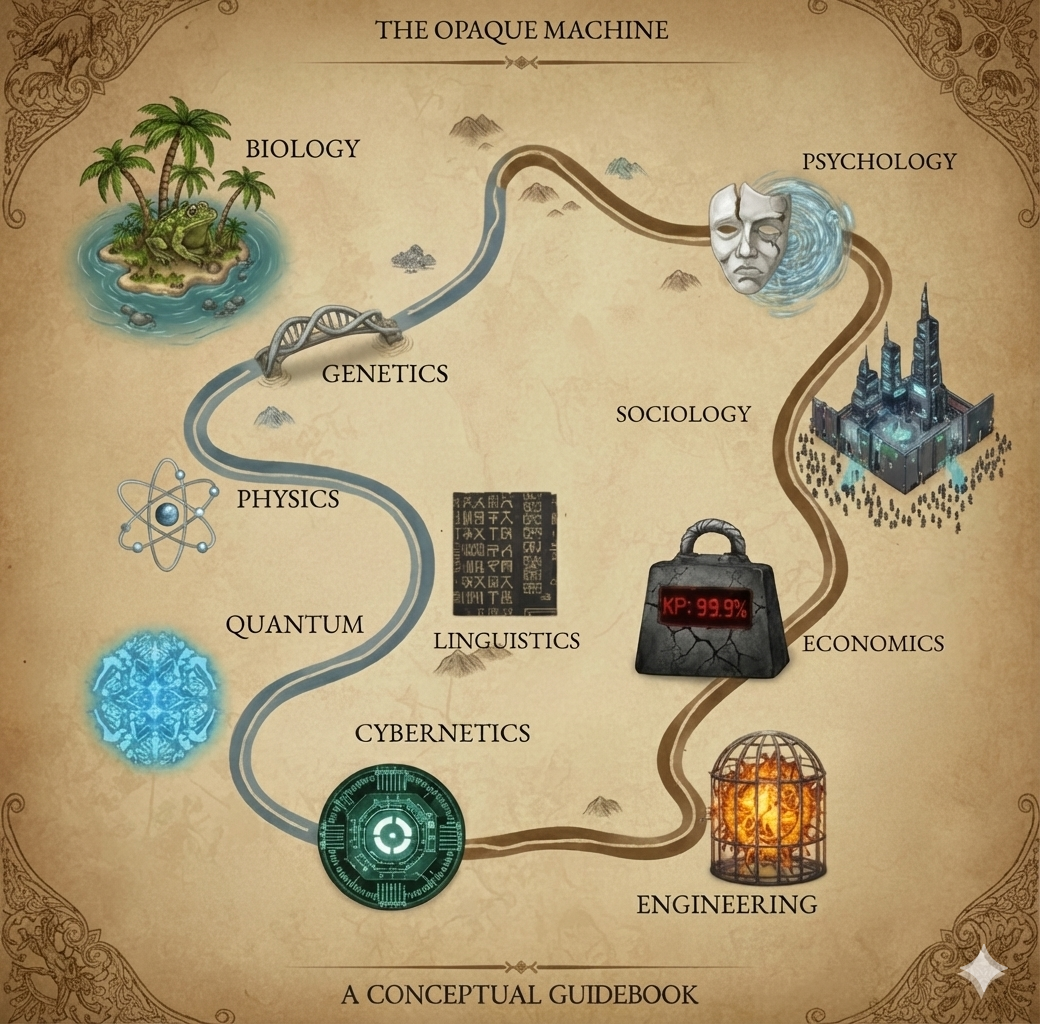
The Opaque Machine refuses to stay in the lane of computer science. It borrows lenses from evolutionary biology, complexity science and genetics to build a fresh vocabulary for AI risk.
In place of the tired contest between tech optimists and doomers, it offers systems thinking: a way to understand machines whose behaviour emerges rather than being designed, and what that means for human agency.
Artificial intelligence is not just another technology.
In The Opaque Machine, the first volume of The Metis Imperative, AI is examined not as ordinary software, but as something far stranger: a system that increasingly behaves less like a tool we designed and more like a complex force we have cultivated. As machines begin to interpret, adapt and act, the old assumptions of control, predictability and engineering discipline begin to break down.
We are building systems whose internal logic we do not fully understand, then placing them into human institutions shaped by flawed incentives, limited foresight and dangerous speed. The result is an unstable interface between an increasingly powerful machine and a deeply fallible operator.
Drawing on the lenses of biology, genetics, physics, history and psychology, The Opaque Machine reframes the AI debate, offering a fresh vocabulary. It explores why optimisation creates hidden trade-offs, why alignment interventions can produce off-target effects, why emergence and adversarial fragility matter, and why fluent language can so easily mislead us into mistaking performance for understanding.
At the heart of the book is a deeper warning: AI is not merely accelerating productivity or automating tasks. It is externalising cognition itself. We are no longer dealing only with tools that wait for instructions. We are entering a world of systems that interpret goals, navigate ambiguity and increasingly shape the environments around them.
For readers interested in artificial intelligence, governance, risk and the future of human agency, The Opaque Machine offers a rigorous and provocative framework for thinking about the most consequential technology of our age.
“This flame stares back”