Volume III | The World
The Atlas Burden
Resources, Sovereignty and the Infrastructure of Survival
In The Atlas Burden, the third volume of The Metis Imperative, the focus shifts from intelligence and biology to the physical world that must sustain them. If the earlier volumes explored the transformation of mind and body, Volume III confronts the harder question beneath both: what must be built, extracted, powered, moved and governed to make any of it possible?
The Argument
Not a book of utopian Promises
The Atlas Burden turns from intelligence and biology to the physical systems that carry them. Its central idea is a mismatch: frontier ambitions built on ageing grids, brittle supply chains and finite resources.
Drawing on mythology, political economy and systems thinking, it treats maintenance as a civilisational function and asks who keeps reliable continuity when systems fail, and who is left exposed.
Civilisation is not self-sustaining. Advanced AI, longevity medicine, autonomous systems and climate adaptation all depend on material foundations—energy, minerals, logistics, grids, labor and political order. Yet modern societies increasingly speak as though digital ambition can float free of thermodynamics, geology and infrastructure. It cannot.
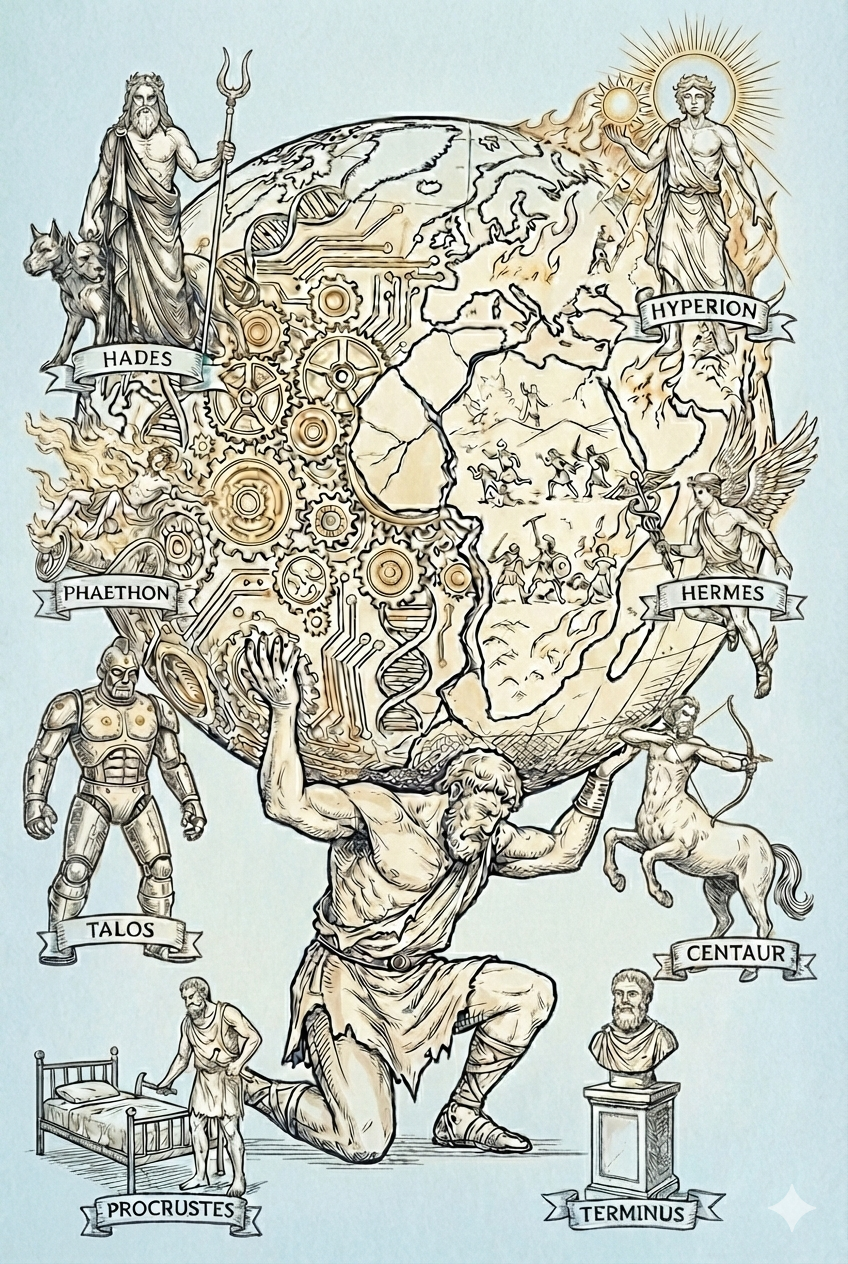
At the center of this volume is the idea of the Atlas Burden: the crushing mismatch between our frontier ambitions and the fragile substrate beneath them. We are trying to build a high-complexity future on top of aging grids, brittle supply chains, finite resources and institutions that struggle to think beyond the next crisis.
The Atlas Burden explores the real weight of the future: sovereignty in an age of dependency, maintenance as a civilisational function, the politics of constraint, and the growing divide between those with reliable continuity and those left exposed to failure.
This is not a book of utopian promises. It is an examination of the physical, institutional and civic realities that will decide whether tomorrow’s capabilities become widely shared civilisation—or brittle privilege for the few.
For readers interested in infrastructure, energy, geopolitics, technology and long-range governance, The Atlas Burden is a call to look beneath the surface of innovation and reckon with what survival actually requires.
“Every Digital Dream has a Physical Invoice”